
Moving the LA 1077 Corridor Forward | St. Tammany Infrastructure & Economic Development
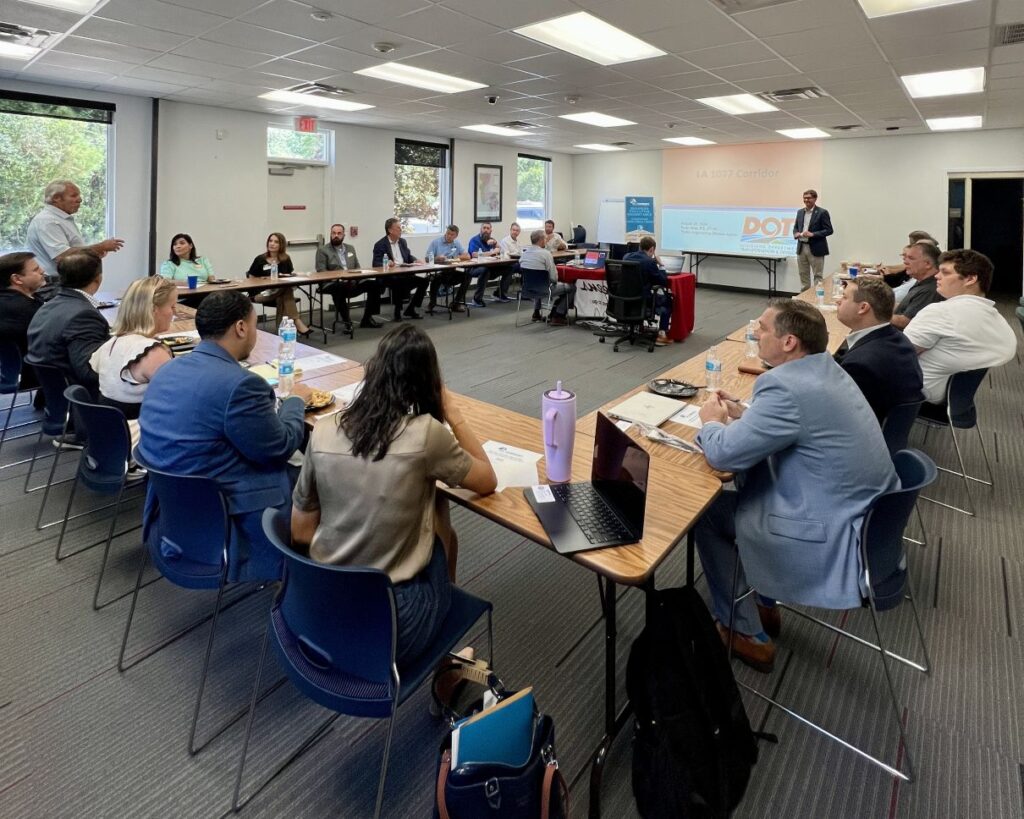
St. Tammany Parish continues to experience significant growth and economic activity, but with that growth comes an increasingly important question:
How do we make sure our infrastructure keeps pace with the opportunities ahead?
That was at the center of a recent Business Executive Roundtable hosted by the St. Tammany Economic Development Corporation (STEDC) along with Greater New Orleans, Inc. (GNO, Inc.), bringing together business executives, economic development leaders, transportation professionals, and public officials for a discussion focused on the future of the Louisiana Highway 1077 corridor.
St. Tammany EDC CEO Russell Richardson described the Parish as being at an important inflection point. Economic activity and investment are creating tremendous opportunities, but transportation and other infrastructure challenges, notably sewer and water, have the potential to constrain that growth if they aren’t addressed strategically.
The roundtable was intended to be more than a discussion about a single roadway. It was an opportunity to bring the public and private sectors together to discuss issues facing St. Tammany Parish and how the business community can work collaboratively with government to move meaningful projects forward.
This idea was born from St. Tammany EDC’s Business Retention Group, led by Tyler Miller under the direction of Russell Richardson.
The Challenge Along Highway 1077
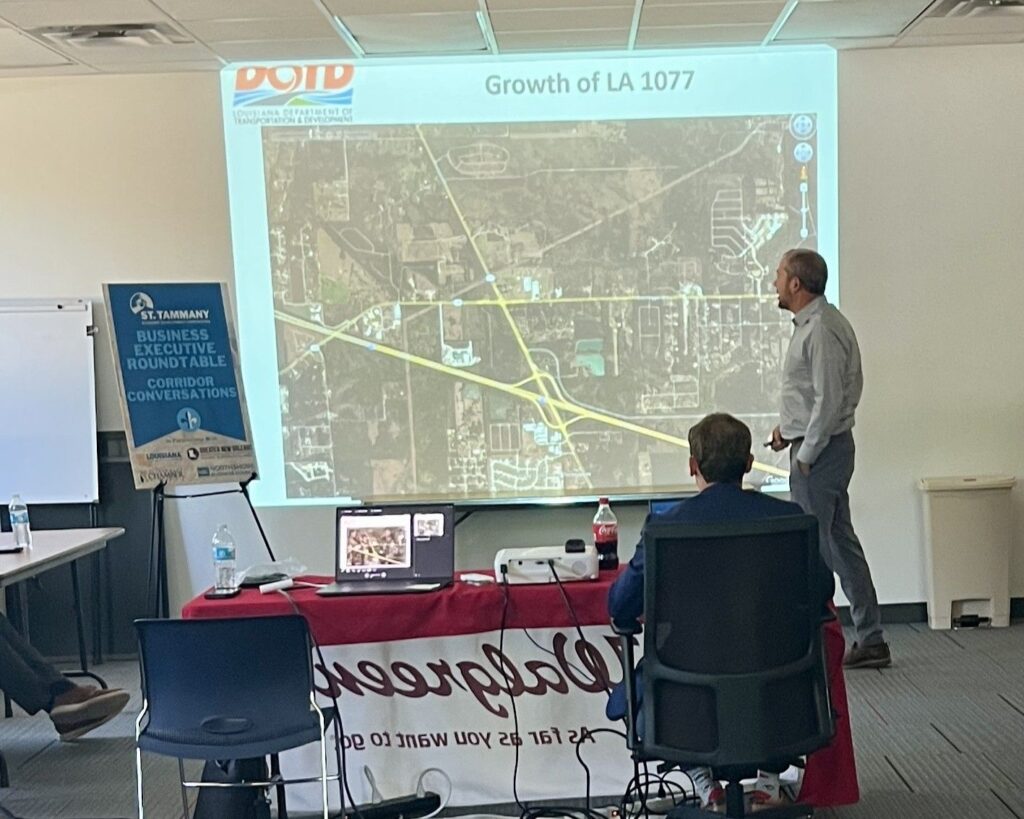
The LA 1077 corridor provides a clear example of the relationship between infrastructure, economic development, and our quality of life.
As development has increased in western St. Tammany Parish, traffic congestion and roadway capacity have become growing concerns.
Ryan Hoyt, P.E., Traffic Engineering Division Administrator with the Louisiana Department of Transportation and Development (DOTD), discussed the transportation planning process and potential improvements to address congestion and capacity along the corridor.
One of the important takeaways was that major transportation improvements move through a lengthy process. The sooner you start planning at the local level and engage the state, the better the outcome.
Before a project can be constructed, the problem must first be studied and potential solutions evaluated. From there, conceptual improvements can be developed, costs estimated, and ultimately funding identified.
And funding is often where the greatest challenge begins.
A Real-World Development Perspective
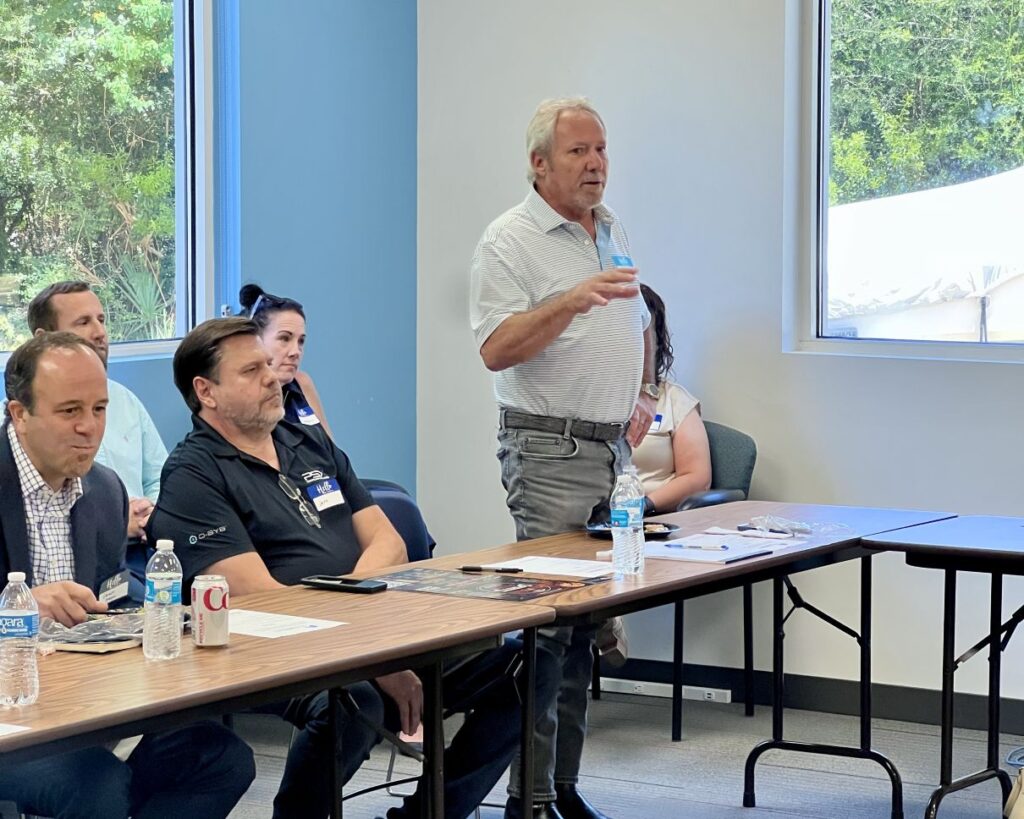
Mike Saucier, President of Gulf States Real Estate Services and Gulf States Construction Services, spoke about the issue from the perspective of someone actively involved in commercial real estate, development, and construction — particularly around our highly valuable interstate corners, many of which have already been identified as important locations for future development.
Infrastructure isn’t separate from economic development. It must be the beginning.
Infrastructure enables economic development.
A property may have development potential on paper, but inadequate roadway or utility capacity and access can create significant challenges for zoning, entitlements, financing, tenant recruitment, and ultimately the feasibility of a project.
Businesses considering a new location have to know that employees, customers, deliveries, and services can safely and efficiently reach that location now and in the future.
Without the necessary infrastructure, development opportunities can stall long before a project reaches design and construction.
Saucier discussed the likelihood that advancing major infrastructure projects along growing corridors will require a myriad of creative planning, funding sources, and partnerships.
That could include traditional public infrastructure funding alongside grants, PILOTs, TIFs, Infrastructure Bonds and other economic-development financing mechanisms, such as the creation of concise development districts, as well as participation from developers, property owners or major users that directly benefit from the improvements.
Rather than waiting for a single funding source to solve the entire problem, the opportunity may be to assemble the right combination of public and private resources to move critical infrastructure forward while supporting responsible economic development.
Planned, Coordinated Growth
Perhaps the most important theme of the roundtable was the need for a planned, coordinated effort and collaboration early in a project’s history.
St. Tammany Parish has significant opportunities ahead, but realizing those opportunities means bringing the appropriate stakeholders into the conversation early, before infrastructure, access, zoning, or financing challenges become obstacles to otherwise viable projects.
That means collaboration among LADOTD, Parish government, economic-development organizations, business leaders, developers, property owners, financing partners, and other stakeholders who can help clearly identify infrastructure needs, establish priorities, and determine how improvements can ultimately be funded and delivered.
A Vision for the LA 1077 Corridor
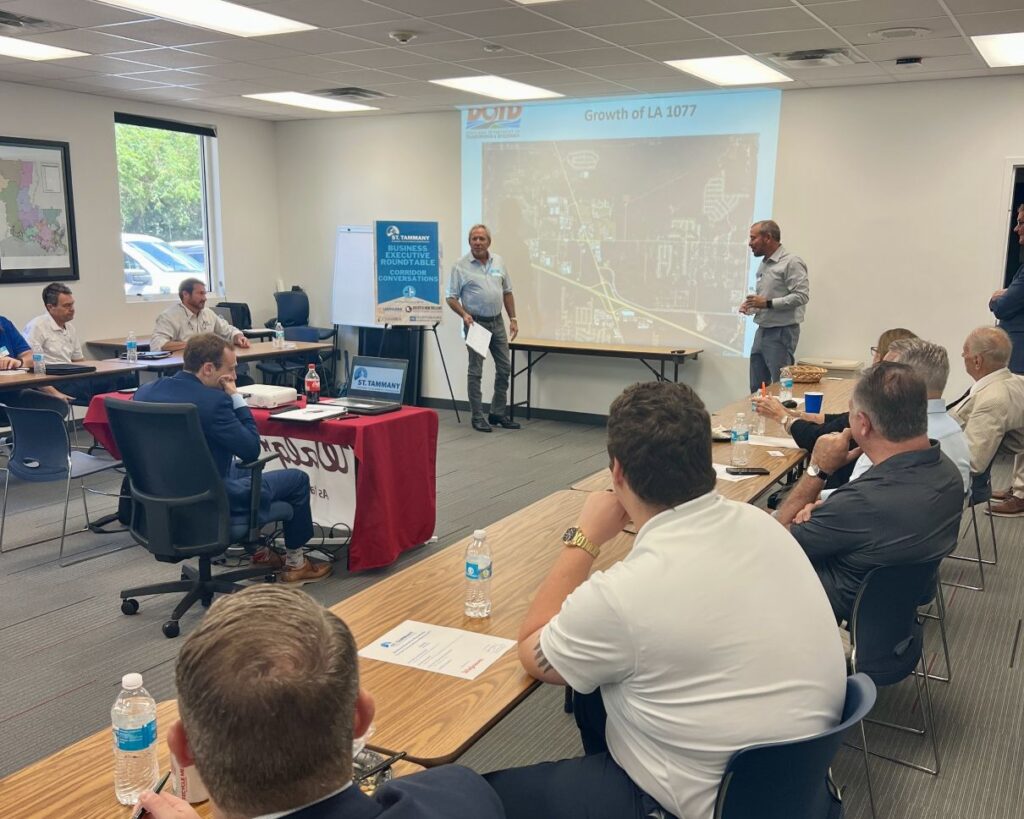
Looking ahead, Saucier believes St. Tammany has an opportunity and obligation to develop a more distinct, defined long-term vision for the LA 1077 corridor, one that connects transportation planning, land use, utilities, and future economic development from the beginning.
That starts with determining where the Parish should focus first.
In the past, St. Tammany Parish has spent a tremendous amount of time addressing zoning, including updating its development codes and ordinances, all of which are important components of responsible growth. However, Saucier believes infrastructure planning must play a leading role in determining how and where future growth occurs.
Having developed properties across the Midwest and Southern United States, Saucier points to communities that established their master road systems early in the planning process as examples of how long-term infrastructure planning can shape successful places to live and do business.
The principle dates back thousands of years to the Roman Empire: establish the transportation roadway framework first, then design the supporting utility infrastructure, and then overlay zoning and let development grow around it. After all, as the saying goes, “all roads lead to Rome.”
This approach is particularly important around St. Tammany’s interstate corridors and interchanges, where access, roadway capacity, and utility infrastructure can determine whether valuable development opportunities ultimately move forward.
The LA 1077 corridor provides an opportunity to establish a model for how that process could work.
Potential transportation improvements and connections, including the relationship between LA 1077, I-12, and Highway 1085, should be considered within a broader 40,000-foot vision for the corridor and evaluated based on both current transportation needs and future development potential.
From there, priorities can be established, and improvements can be matched with potential funding mechanisms, whether through grants, PILOTs, TIFs, infrastructure bonds, or other public-private financing strategies.
The goal is not simply to build roads.
It is to establish a coordinated framework in which transportation, utilities, land use, zoning, economic development and financing work together from the beginning.
Drainage must also remain a critical part of that framework. St. Tammany has established stringent drainage requirements intended to protect surrounding properties and communities as development occurs. Saucier believes that when those requirements are simply followed, the Parish can continue supporting responsible development while maintaining those important protections.
Moving the Conversation Forward
We appreciate St. Tammany Economic Development Corporation, St. Tammany Parish Government, Greater New Orleans, Inc., Louisiana Economic Development, St. Tammany Chamber of Commerce, Northshore Business Council, and the participating businesses and public- and private-sector leaders for bringing these conversations together and working toward a stronger, more prosperous St. Tammany Parish and Northshore region.
Planning a Real Estate, Construction or Development Project?
Successful projects require more than finding the right property or building the right facility. Infrastructure, site feasibility, access, utilities, entitlements, construction, and long-term development strategy all play a role in determining whether an opportunity can move forward.
Gulf States Real Estate, Gulf States Construction, and Gulf States Development Services work with property owners, businesses, developers, and investors to evaluate opportunities, navigate complex projects, and develop practical solutions from early planning through execution.
If you are considering a commercial real estate, construction, or development project in St. Tammany Parish, the Northshore, or throughout the Gulf South, we welcome the opportunity to discuss it.
Gulf States Real Estate Services
📞 985-792-4386
✉️ info@gsres.com